Why My Dog Is Reactive to Certain Dogs: A Dog Trainer Explains What Most Owners Miss
By Jesse | Canine Perspective
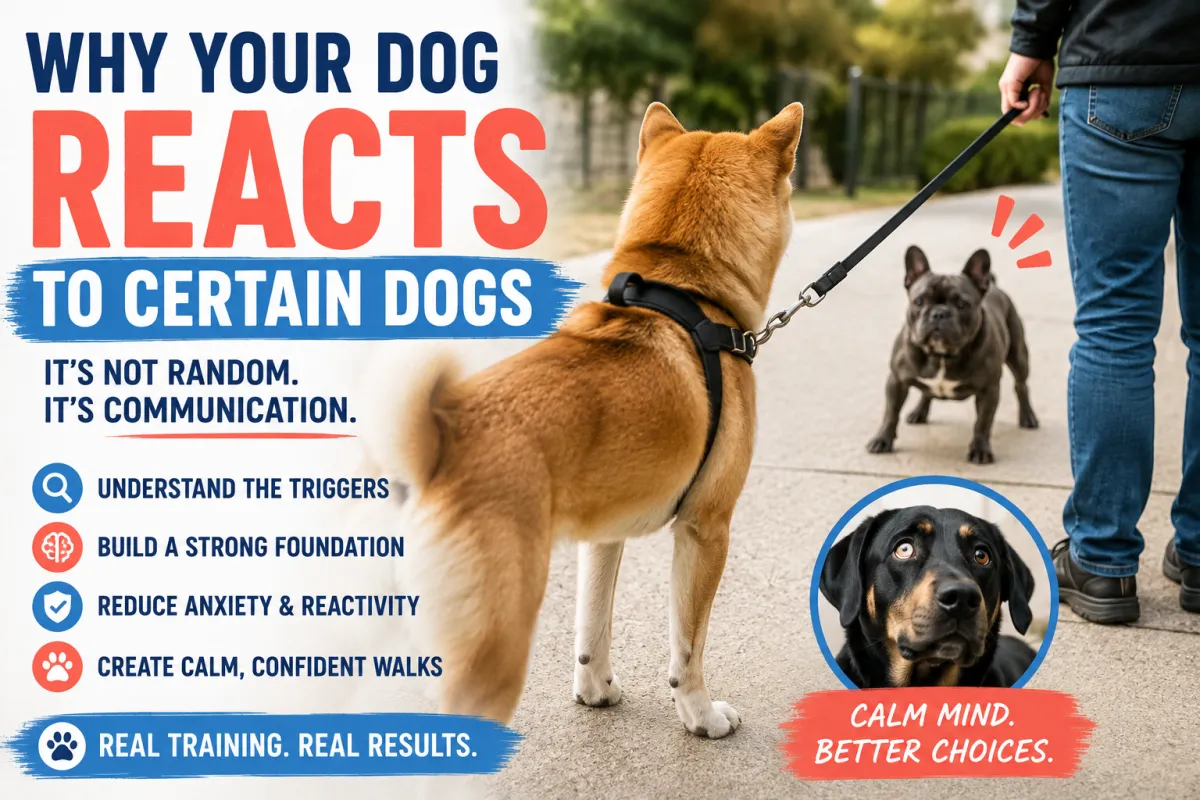
If your dog seems perfectly friendly most of the time but suddenly fixates on specific dogs, the problem usually isn't random. Understanding the foundation behind leash reactivity can change everything.
Watch The Consultation
One of the most frustrating situations for dog owners is having a dog that behaves perfectly around most dogs but suddenly becomes reactive toward specific breeds, colors, personalities, or energy levels.
One day your dog ignores ten dogs on a walk.
The next day they lock onto a French Bulldog, Corgi, Shiba Inu, or another dog seemingly "for no reason."
Many owners begin asking themselves:
Is my dog becoming aggressive?
Was my dog traumatized?
Is this territorial behavior?
Why only certain dogs?
These are excellent questions, but they're often approached from the wrong perspective.
As professional dog trainers, we don't simply look at the dog that was reacted to.
We look at what your dog is thinking before the reaction ever happens.
One of the biggest misconceptions about leash reactivity is assuming the dog dislikes every dog they see.
In reality, many reactive dogs:
Play well with familiar dogs.
Attend daycare successfully.
Live peacefully with other dogs.
Enjoy off-leash play under the right circumstances.
The issue isn't necessarily dogs.
It's certain situations, certain energy, or certain triggers hat push the dog over threshold.
That distinction changes how training should be approached.
Humans naturally assume another friendly dog is simply...
"...another friendly dog."
Dogs don't always see it that way.
A reactive dog may instead perceive:
Potential threat
Unstable energy
Something worth regulating
Something worth driving away
Even when the approaching dog has completely friendly intentions.
Understanding this difference is critical because training based on human emotion often misses what the dog is actually communicating.
Many owners notice patterns.
Their dog may consistently react toward:
French Bulldogs
Corgis
Shiba Inus
Orange-colored dogs
Fluffy breeds
High-energy puppies
That doesn't necessarily mean the breed itself is the issue.
Instead, trainers look for common characteristics like:
Excitement level
Direct eye contact
Tense posture
Intense movement
Pushy social behavior
Previous experiences
The more patterns we identify, the easier it becomes to reproduce and solve the behavior during training.
This is where many training programs fail.
A dog may know:
Sit
Down
Come
Stay
Place
...and still struggle with:
Reactivity
Anxiety
Whining
Lunging
Fixating
Territorial behavior
Those are behavioral issues—not obedience issues.
Think of it this way:
Obedience is like education.
Behavior is like character.
A highly educated person can still make poor decisions.
Likewise, a dog with excellent obedience can still display unwanted behaviors if the foundation wasn't built correctly.
One of the biggest takeaways from this consultation is that heel isn't just about walking nicely.
Related Article: Why Heel Is The First Command We Teach With E-Collar
Heel teaches:
Structure
Accountability
Focus
Calmness
Pressure management
Emotional regulation
When taught correctly, heel becomes the foundation for solving:
Pulling
Whining
Anxiety
Leash reactivity
Fixating on other dogs
Without that foundation, it's difficult to communicate effectively during real-world situations.
Many reactive dogs don't start at a calm baseline.
Instead, they begin every walk already stressed.
Common signs include:
Constant whining
Panting
Pulling
Hypervigilance
Difficulty relaxing
Constant scanning of the environment
Once a trigger appears, they're already emotionally elevated.
That makes reactions happen much faster.
Training should focus on lowering the dog's overall stress level—not simply correcting the reaction itself.
Owners are often surprised when daycare reports:
"Your dog is perfect."
Meanwhile, the same dog reacts on neighborhood walks.
This isn't unusual.
Environment matters.
A structured daycare often removes:
Territorial responsibility
Owner attachment
Resource guarding opportunities
Familiar walking routines
Without those factors, many dogs behave very differently.
That doesn't mean the underlying issue has disappeared.
When properly conditioned, an e-collar becomes a communication tool—not simply a punishment tool.
The goal isn't to shock a dog into submission.
The goal is to teach the dog:
How pressure turns on
How pressure turns off
How calm decisions create relief
Only after that communication system is established should it be used to address behavioral issues like:
Fixation
Anxiety
Whining
Leash reactivity
Without proper conditioning, owners often end up repeatedly pressing the button without meaningful improvement.
Many owners want immediate socialization.
Professional training works differently.
Instead of immediately introducing difficult dogs, we first build:
Heel
Recall
Neutrality
Emotional stability
Clear communication
Only after those foundations exist do we begin exposing the dog to increasingly challenging situations.
That progression produces more reliable, long-term results than simply hoping repeated exposure fixes the issue.
If your dog only reacts to certain dogs, don't assume the behavior is random.
There's usually a pattern.
The challenge is identifying what your dog is actually responding to and building the foundation needed to communicate through those moments.
Whether the trigger is excitement, territorial behavior, anxiety, or specific types of dogs, lasting improvement starts long before the reaction itself.
When you understand how dogs perceive the world—and give them clear structure through consistent training—you can begin replacing uncertainty with confidence, both for your dog and for yourself.