Reactive Dog Daycare: Can Daycare Help or Make Your Dog's Behavior Worse?
Many owners hope daycare will socialize their reactive dog, but in some cases it can reinforce unwanted behaviors. Here's how to determine whether daycare is helping your dog—or making the problem worse.
By Jesse | Canine Perspective
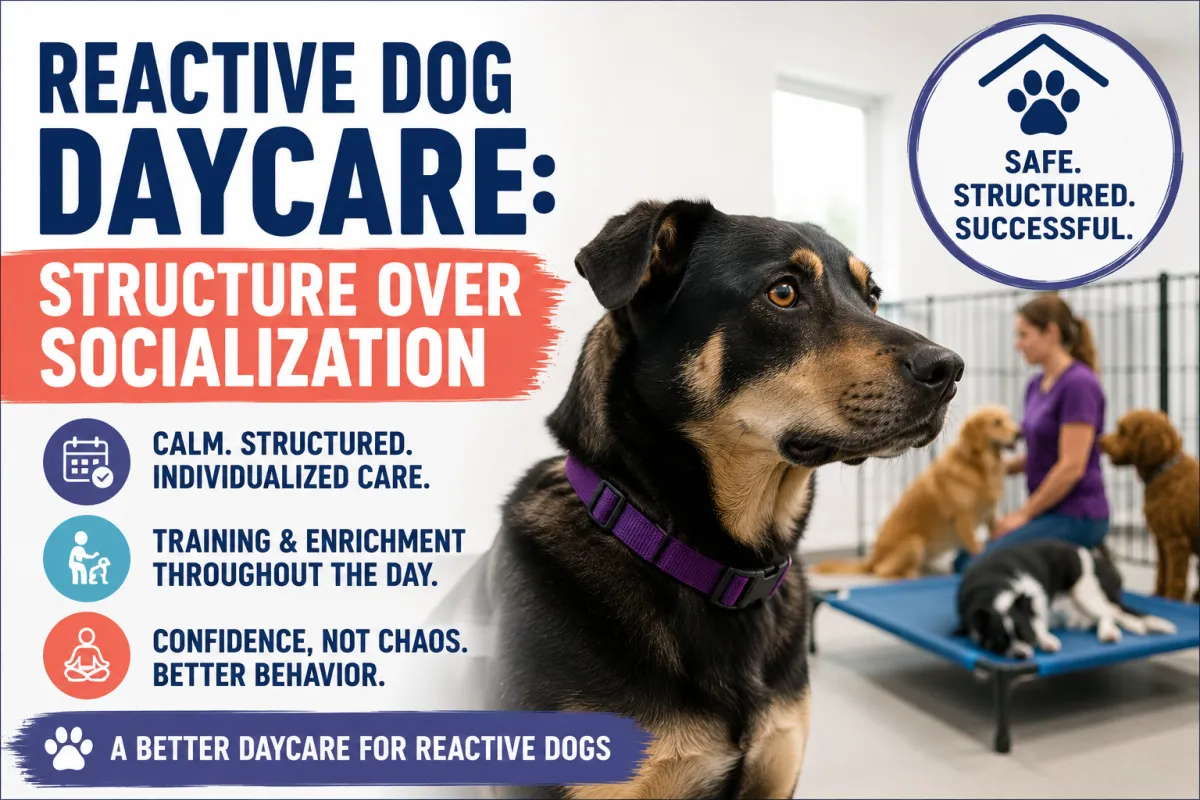
At Canine Perspective, we've built our daycare program differently because we understand that not every dog thrives in a traditional daycare environment. Many reactive, anxious, fearful, or behaviorally challenged dogs are overwhelmed by large playgroups, constant stimulation, and unstructured socialization. Instead of expecting every dog to fit the same model, we create individualized plans that prioritize structure, training, and emotional stability. Through supervised interactions, controlled social exposure, rest periods, and a structured routine, our goal is to help reactive dogs be relaxed as possible and not just lock them away from all the other dogs. We've successfully worked with many dogs that were turned away by other daycare facilities, giving them a safe environment where they can continue learning while their owners have peace of mind.
Related Article: From Expelled To Thriving, How Training & Structure Changed Doug's Life Without Medication
Most dog owners have heard the same advice:
"Your dog just needs more socialization."
So they enroll their reactive dog in daycare, hoping that spending time around other dogs will improve their behavior.
Sometimes it does.
But many times, it doesn't.
In fact, for certain dogs, daycare can actually make reactivity worse if it's not structured correctly.
As a dog behavior expert and professional dog trainer, I've worked with countless dogs that were either rejected from daycare because of their behavior or developed new behavioral issues after attending facilities that prioritized group play over individual learning.
The truth is that daycare isn't automatically good or bad. The outcome depends on your dog's temperament, the structure of the program, and whether the environment supports healthy behavior rather than simply managing chaos.
A reactive dog is one that has an exaggerated emotional response to a specific trigger.
Those triggers may include:
Other dogs
People
Children
Bicycles
Cars
Animals
Loud noises
Leashes
Reactivity isn't always aggression.
Some reactive dogs bark because they're fearful.
Others become overly excited.
Some are frustrated because they want to greet every dog they see.
Understanding why your dog reacts is far more important than simply labeling the behavior.
The answer depends on why your dog is reactive.
Some dogs benefit from carefully managed exposure to calm, neutral dogs.
Others become increasingly overstimulated by constant excitement and group play.
A quality daycare evaluates each dog individually rather than assuming every dog belongs in a large social group.
Good daycare isn't about keeping dogs busy.
It's about creating an environment where dogs can make good decisions, relax, and learn appropriate social skills.
One of the biggest misconceptions in dog training is that reactive dogs simply need "more dogs."
In reality, many reactive dogs need better experiences, not more experiences.
Repeated exposure without structure can actually rehearse unwanted behaviors.
If your dog spends every daycare visit:
Barking at other dogs
Fixating on movement
Chasing excessively
Becoming overwhelmed
Ignoring handlers
...those behaviors become stronger through repetition.
Practice doesn't make perfect.
Practice makes permanent.
Pay attention to how your dog behaves after daycare.
Some warning signs include:
Increased barking on walks
Greater leash reactivity
Difficulty settling at home
Heightened excitement around other dogs
Increased anxiety
Poor impulse control
Constant scanning of the environment
If your dog's behavior continues to deteriorate after repeated daycare visits, the environment may not be supporting the emotional state you're trying to build.
Not every daycare is designed for reactive dogs.
Facilities that successfully work with behavior cases typically focus on:
Structured play instead of uncontrolled group play
Dogs don't need to interact nonstop.
They benefit from scheduled activity followed by downtime.
Small compatible groups
Dogs are grouped by:
Play style
Energy level
Confidence
Size
Temperament
Not simply by availability.
Reinforcing structure throughout the day
The best facilities reinforce:
Calm Behavior
Correcting Unwanted Behaviors
Walking Politely
Routine
Expecting good behavior shouldn't stop just because your dog is boarding or attending daycare.
Rest periods
Dogs need time to decompress.
Many behavioral issues stem from chronic overstimulation rather than lack of exercise.
Experienced staff
Understanding dog behavior is critical.
Staff should recognize stress signals long before conflict occurs and intervene appropriately.
Many reactive dogs thrive in programs that combine:
Individual walks
Training sessions
Structured enrichment
Controlled social exposure
Rest periods
Rather than spending eight hours playing with unfamiliar dogs.
The goal isn't exhausting your dog.
The goal is creating emotional stability.
Being asked to leave a daycare doesn't necessarily mean your dog is "bad."
It usually means the facility wasn't equipped to manage your dog's behavioral needs.
Many traditional daycare facilities are designed for already-social dogs.
Behavior modification requires different protocols, different staffing, and a completely different approach.
We've helped many dogs that were previously turned away from daycare develop the skills needed to safely participate in structured environments.
Sometimes.
But play shouldn't be the first objective.
Before socialization comes:
Neutrality
Focus
Emotional regulation
Clear boundaries
Once those foundations exist, appropriate social interactions become far more successful.
Dogs don't need dozens of friends.
They need the ability to remain calm regardless of what's happening around them.
The best daycare programs don't replace training.
They reinforce it.
A structured daycare should support the behaviors you're teaching at home, creating consistency rather than confusion.
When training and daycare work together, dogs learn that the same expectations apply everywhere—not just during formal training sessions.
Reactive dogs deserve more than simply being placed into a playgroup and hoping things improve.
Successful behavior modification requires understanding why the dog is reacting, creating structured experiences, and building confidence through clear communication.
For some dogs, daycare is an incredible tool.
For others, it can unintentionally reinforce the very behaviors owners are trying to eliminate.
The key isn't asking whether daycare is good or bad.
The better question is:
Is this daycare helping my dog become calmer, more confident, and more successful in everyday life?
If the answer is yes, you've found the right environment.
If not, it may be time to explore a more structured program that prioritizes training, behavior, and long-term success over nonstop play.