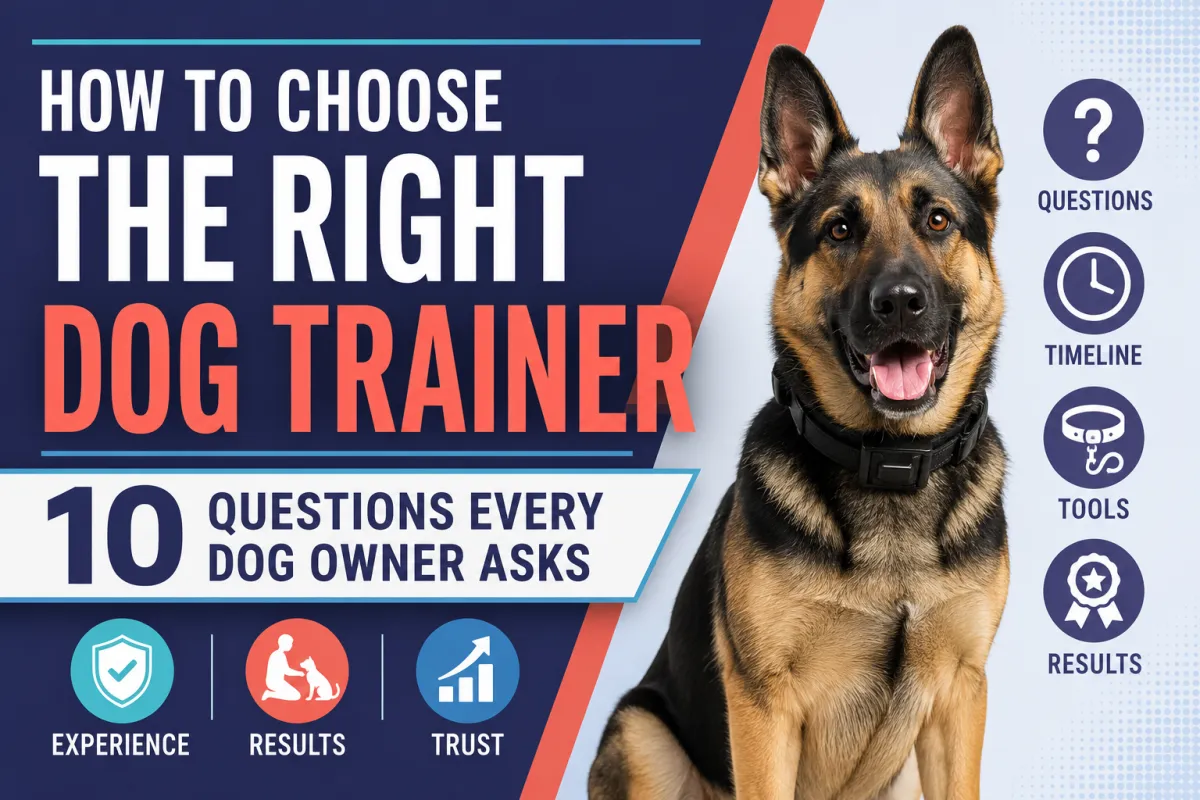
How to Choose the Right Dog Trainer: Honest Answers to the 10 Questions Every Dog Owner Asks
Before investing in dog training, understand what really matters, what questions to ask, and how to find a trainer who is the right fit for you and your dog.
By Jesse | Canine Perspective
Introduction
Hiring a dog trainer is a big decision.
Whether your dog pulls on the leash, barks at every passing dog, struggles with aggression, or you've just brought home a new puppy, finding the right trainer can dramatically influence your dog's future.
Unfortunately, dog training is an unregulated industry. Anyone can call themselves a dog trainer, regardless of experience, education, or results. That leaves dog owners sorting through conflicting advice, social media opinions, and marketing claims.
This guide answers the ten most common questions people ask before hiring a dog trainer, helping you make an informed decision based on your goals, your dog's needs, and the trainer's experience.
The best dog trainer isn't necessarily the one with the biggest following or the most certifications.
Instead, look for someone who:
Has experience with your specific problem
Can clearly explain why they're doing something
Is transparent about their methods
Prioritizes safety for both dogs and people
Provides realistic expectations rather than guarantees
Has documented success stories and client testimonials
If your dog has aggression or severe behavioral issues, choose someone who specializes in behavior modification—not just obedience training.
The trainer should also be willing to answer your questions instead of dismissing your concerns.
Consultations are required before starting any dog training program with Canine Perspective. During the consultation Jesse assesses any behavioral issues, provides insight into the behavior, gives his recommendation on training program, and explains the tools and methodology. This allows dog owners to make an educated decision on whether or not to move forward with their dog's training.
For most owners, absolutely.
Good training isn't simply about teaching commands.
It's about:
Better communication
Safer behavior
Increased confidence
Reduced stress
More freedom for your dog
Stronger relationships between owners and their dogs
Many behavioral problems become more expensive—and more difficult to address—the longer they're ignored.
Training is often an investment that prevents years of frustration.
Many owners successfully teach basic manners at home.
However, if your dog:
Shows aggression
Displays fear-based behaviors
Lunges on leash
Has severe anxiety
Isn't improving despite your efforts
Makes you feel overwhelmed
Professional guidance can significantly shorten the learning curve.
An experienced trainer often recognizes subtle behavioral patterns that owners don't notice.
Before committing, ask questions like:
How long have you been training dogs?
Have you worked with dogs like mine?
What methods do you use?
Why do you recommend those methods?
What results should I realistically expect?
What happens if my dog struggles?
Do you provide follow-up support?
How involved will I be during training?
Can I see client success stories?
What happens if I don't see results?
Good trainers welcome questions.
They should educate—not pressure—you.
There's no universal timeline.
It depends on factors including:
Your dog's age
Genetics
Temperament
Previous learning history
Consistency at home
Frequency of training
Severity of behavioral issues
Basic obedience may take several weeks depending on how advanced the owner wants it to be. In the beginning we teach things quickly as the obedience is simple. Heel, Stay, Sit, etc. Once we get to the off-leash stage is where time comes into play as owners need to practice everything until they feel confident in their dog's off-leash obedience.
Complex aggression or reactivity cases often require months of consistent work. In my experience, clients will begin to see enough progress almost immediately after the first class. This is important because it keeps them motivated to stick with the methods until we achieve our goal.
Remember:
Dog training isn't about reaching a finish line.
It's about building lifelong habits.
Every dog is different.
Some owners only need a few sessions to improve communication.
Others benefit from ongoing coaching.
Generally speaking:
Puppies often benefit from multiple structured sessions.
Basic obedience usually requires several lessons plus consistent practice.
Off-leash obedience will take a few months to give enough time to be confident enough to let your dog off-leash.
Behavior modification often involves a customized training plan with follow-up sessions.
A trustworthy trainer won't promise an exact number before evaluating your dog.
Yes—but only when everyone participates.
Professional trainers don't simply train dogs.
They teach owners.
The best results happen when:
Owners remain consistent
Expectations are realistic
Training continues between sessions
Dogs receive clear communication
Everyone in the household follows the same rules
Training isn't magic.
It's education, repetition, and consistency.
Related Article And Client Success Story
My Reactive Dog Keeps Getting Worse, Why?
Not when they're run properly.
Unfortunately, some facilities prioritize volume over individualized care.
A quality board and train program should provide:
Daily structured training
Mental enrichment
Exercise
Proper supervision
Transparent communication
Regular progress updates
Owner transfer sessions before graduation
The goal isn't simply to train the dog while you're away.
It's to create lasting success once your dog returns home. Be sure to do your research when choosing a B&T because many will offer very little support once the program is done. I've had several clients share their story of only receiving a 30-minute follow up for a 4-Week Board & Train! There's no way 30 minutes is enough to cover what a dog can learn in 4 weeks.
Canine Perspective's B&T programs come with one training video per week to help explain the training process. These videos are all filmed using the client's dog so they are seeing how their dog is responding and progressing with the training.
When properly introduced, correctly fitted, and used by educated handlers, modern remote training collars can be effective communication tools.
Problems typically arise from:
Poor instruction
Incorrect fit
Inconsistent timing
Excessive stimulation
Using the tool without first teaching the dog what it means
Like any training equipment, the effectiveness depends far more on the person using it than the equipment itself.
Owners should receive professional instruction before incorporating an e-collar into a training program.
Prong collars generate strong opinions.
The reality is that improper use of any training equipment—including flat collars, harnesses, slip leads, or retractable leashes—can create problems.
When properly fitted and used as part of a structured training program, a prong collar distributes pressure evenly around the neck rather than concentrating it in one location.
The key is education.
A poorly fitted prong collar can be ineffective or uncomfortable.
A properly fitted collar, combined with clear instruction and fair handling, can improve communication while reducing pulling and increasing safety for both the dog and handler.
The tool itself isn't what determines humane training.
Knowledge, timing, consistency, and responsible use do.
Finding the right dog trainer isn't about choosing the cheapest option or the one with the biggest social media following.
It's about finding someone who understands your goals, communicates clearly, prioritizes safety, and has experience helping dogs like yours.
Ask questions.
Expect honest answers.
Look for transparency instead of promises.
Most importantly, remember that successful dog training is a partnership between the trainer, the owner, and the dog.
When everyone works together with consistency and realistic expectations, remarkable progress is possible.