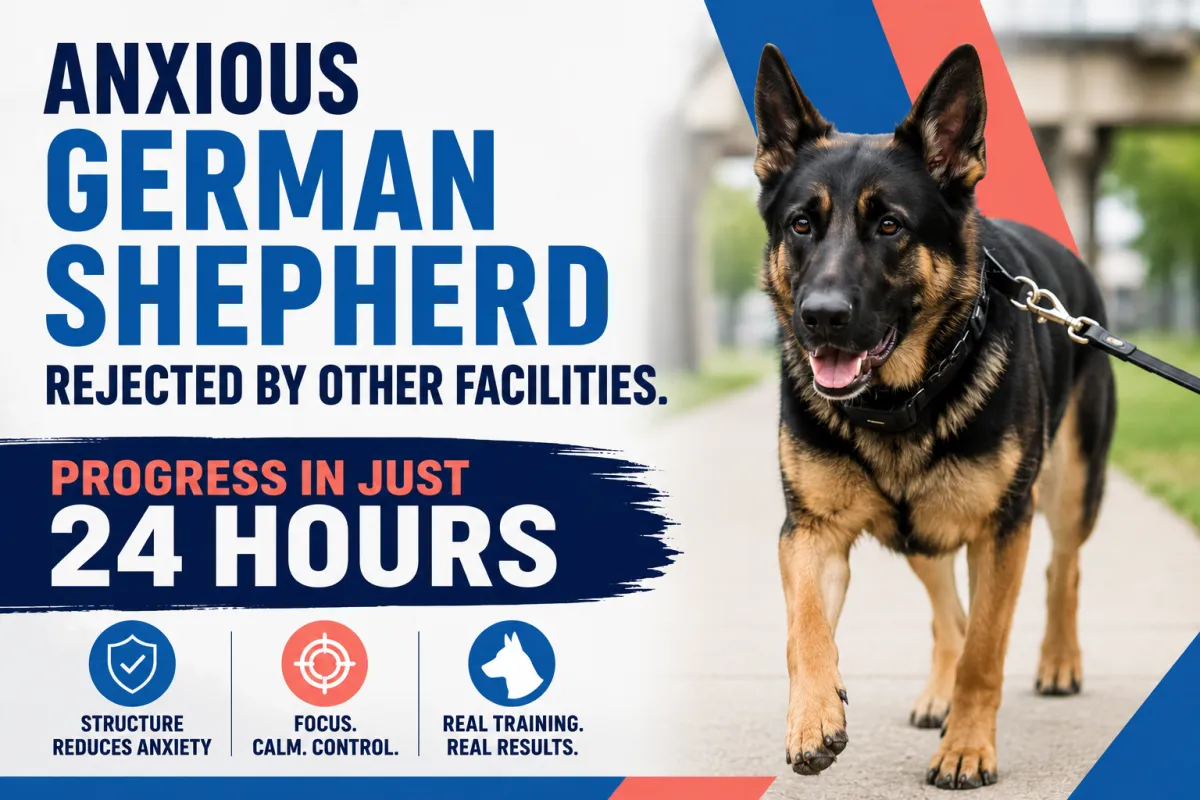
Anxious German Shepherd Rejected By Other Daycare & Boarding Facilities Shows Progress In 24 Hours
By Jesse | Canine Perspective
Max is an anxious German Shepherd who has struggled in traditional daycare and boarding environments. Other facilities have accepted him, only to contact his owners within hours and ask them to take him home. His owners bring him from Niles, Illinois as we're the only daycare and boarding facility that can care for him.
His anxiety can intensify until he becomes reactive, defensive, and difficult for unfamiliar handlers to manage.
But is Max truly aggressive—or is he an anxious, misunderstood dog who has not received the structure and communication he needs?
In this behind-the-scenes board-and-train case study, we follow Max during his first outdoor heel-training session at Canine Perspective. At the time of filming, he had been with us for only about 26 hours. Despite being early in the program, he was already beginning to focus, settle, and understand what was expected of him.
Max arrived at Canine Perspective for a two-week board-and-train program. He is a highly anxious German Shepherd whose stress has made traditional boarding and daycare difficult.
When his anxiety rises, he may growl, become defensive, or display reactive behavior. That has led other caretakers and facilities to conclude that they cannot safely manage him.
His owners have tried to find appropriate care. They have used daycare services, boarding providers, Rover sitters, a prong collar, and an e-collar. The issue was not a lack of effort.
The missing piece was a clear, consistent training methodology that showed Max what to do when he felt overwhelmed.
Many boarding and daycare facilities are equipped to manage social, easygoing dogs. They may not have the staff training, handling protocols, or behavioral experience needed for dogs whose anxiety turns into reactivity.
When Max becomes overwhelmed, his stress can increase rapidly. Staff may interpret growling, barking, or defensive behavior as evidence that he is inherently aggressive.
That distinction matters.
A truly aggressive dog may actively seek conflict or attempt to bite when approached. A reactive dog may bark, lunge, growl, or posture because the dog is frightened, overstimulated, frustrated, or unsure how to respond.
Max showed defensive behavior during an early interaction, but he did not follow through when safely evaluated. Once communication and structure were introduced, he became manageable and allowed additional staff members to handle him by the end of his first day.
That does not mean every anxious dog is safe or that warning behavior should be ignored. It means behavior must be evaluated in context.
Max was highly anxious when he first arrived. That was expected. He had been separated from his owners, entered an unfamiliar environment, and was surrounded by new smells, sounds, dogs, and people.
The first goal was not to overwhelm him with freedom or entertainment. It was to give him structure.
He began learning:
How to follow the handler’s movement
How to maintain a heel position
How to respond to leash and e-collar communication
How to disengage from distractions
How to settle instead of remaining hypervigilant
How to look to the handler for direction
Within roughly 26 hours, Max was able to complete his first outdoor heel-training walk with us. He was not perfect, nor would we expect him to be. He still drifted toward scents, became distracted, and showed caution.
But he was already beginning to process the training and focus his brain.
Watch Max's Consultation
One of the first parts of remote-collar training is finding the dog’s working level.
The working number is not a universal setting. It can change depending on:
The dog’s sensitivity
Environmental distractions
Anxiety level
Arousal
Familiarity with the tool
The behavior being addressed
The dog’s understanding of the exercise
During this walk, Max initially responded around the upper 20s and low 30s. His previous session had required higher levels because he was more anxious and had less understanding of the communication.
As a dog learns how to respond, the working level may decrease. It may also temporarily increase in a distracting environment.
The number itself is not the goal. The goal is effective communication.
An anxious dog may enter the world feeling responsible for noticing and responding to everything.
A truck passes.
A dog barks.
A stranger approaches.
A scent appears.
A sudden noise occurs.
Without guidance, the dog may believe every environmental change requires investigation, avoidance, defense, or a reactive response.
Structured heel training gives the dog a different job:
Stay with the handler, follow direction, and allow the handler to manage the environment.
This does not mean the dog must never look around. Max was allowed to notice things around him as long as he continued moving appropriately and remained within the acceptable heel position.
The problem begins when attention turns into fixation, forging, pulling, scanning, or escalation.
By redirecting Max before he became overwhelmed, we helped him practice calm, focused movement instead of rehearsing anxious behavior.
Reactive behavior can look frightening.
A reactive dog may:
Bark
Growl
Lunge
Pull
Stiffen
Fixate
Raise its hackles
Appear difficult to control
Those behaviors can create a genuine safety risk, but they do not necessarily mean the dog is going to attack.
For Max, anxiety and environmental pressure appear to contribute heavily to his behavior. When he becomes overwhelmed, he can move toward defensive reactions.
Other facilities may see the outward behavior and label him aggressive without identifying the emotional state producing it.
That can lead to the wrong response.
A dog experiencing anxiety may need:
Clear structure
Predictable handling
Appropriate consequences
Controlled exposure
Reduced opportunities to rehearse reactive behavior
A handler capable of reading early stress signals
The label matters less than accurately understanding what is driving the dog.
Max’s owners already had access to a prong collar and an e-collar. Their willingness to seek help was not the issue.
The challenge was knowing:
When to apply pressure
How much pressure to use
When to release it
Which behavior to correct
Which behavior to allow
How to reward correct decisions
How to read the dog’s response
How to adjust as the environment changes
A tool does not train a dog by itself.
Using an e-collar without a clear system can create confusion. Using a prong collar without timing or follow-through may produce pulling, conflict, or frustration.
The tool must become part of a consistent language the dog understands.
Heel is often treated as a cosmetic obedience command. For anxious and reactive dogs, it can be much more valuable.
A structured heel teaches the dog to:
Follow instead of lead
Remain aware of the handler
Move through distractions without fixating
Accept guidance
Regulate speed and position
Avoid impulsively investigating every sight, sound, or scent
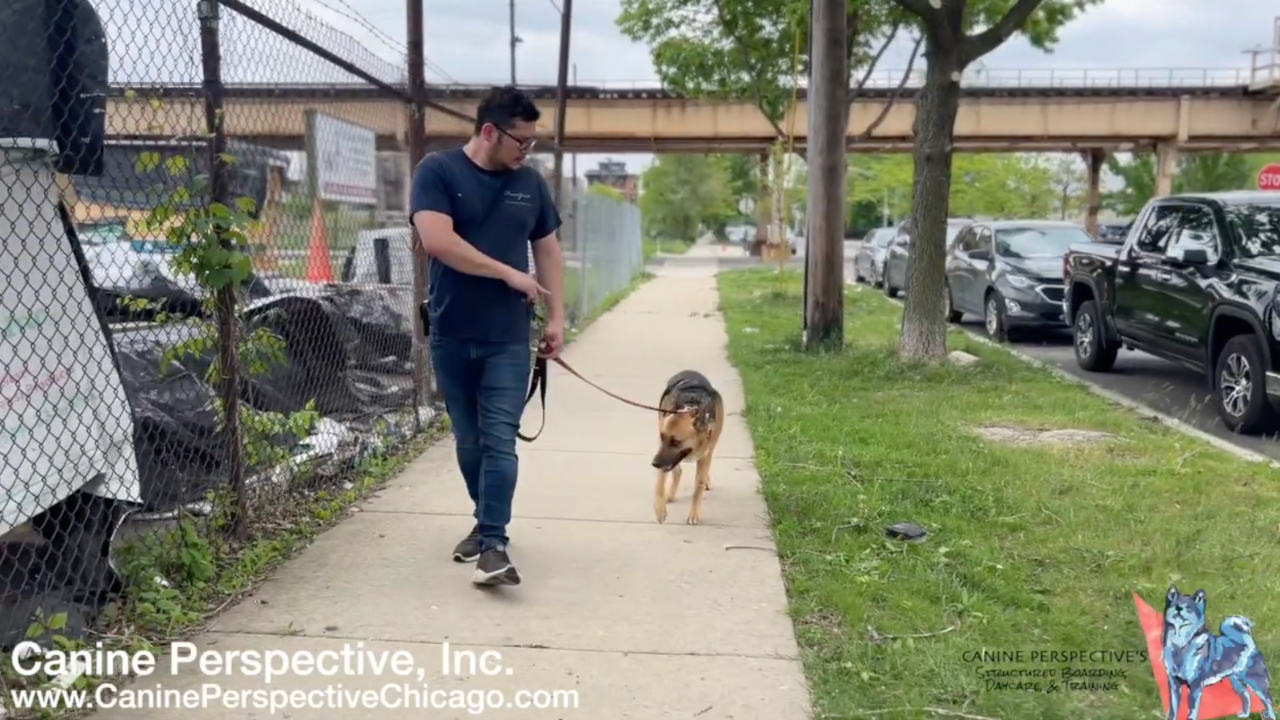
During Max’s first outdoor session, he occasionally forged ahead or drifted toward distractions. Each correction brought him back into the exercise.
Over time, that repetition teaches the dog that environmental distractions are not commands. The handler’s direction is what matters.
This can be especially useful for dogs that feel responsible for guarding their owners or monitoring the environment.
Barking, lunging, growling, and territorial behavior are visible symptoms.
The root problem may include:
Anxiety
Lack of impulse control
Frustration
Inconsistent boundaries
Poor communication
Excessive responsibility placed on the dog
Inability to settle
If we only attempt to suppress the outward behavior without changing the dog’s state of mind, the problem often returns.
With Max, the broader goal is to help him understand that he does not have to manage every situation.
His handler will tell him:
Where to walk
When to move
When to stop
What deserves attention
What he can safely ignore
That clarity can reduce the pressure he places on himself.
Dog owners often become discouraged when they are told meaningful behavior change will take years.
Some cases do require extensive time, careful management, and continued support. However, owners need to see enough progress to remain motivated.
When the communication system is clear, early improvement can happen quickly.
Max’s first outdoor heel session did not mean his anxiety was cured after one day. It demonstrated that he was capable of learning, focusing, and responding despite his history.
That early success gives the trainer and owner a foundation to build upon.
A board-and-train program does not remove the owner from the process.
Max can learn the commands and communication system with our team, but his owners must learn how to maintain that structure when he returns home.
Successful transfer requires:
Learning how to use the equipment
Practicing the same commands
Maintaining consistent expectations
Following through on corrections
Recognizing anxiety before it becomes reactivity
Avoiding a return to old routines
Continuing structured walks and obedience
The trainer can establish the foundation. The owner must maintain it.
Max is not simply a “bad dog” or an “aggressive German Shepherd.”
He is an anxious dog whose behavior has become difficult for people to manage when his stress rises beyond his ability to cope.
His early progress illustrates an important lesson:
Dogs often improve when we stop reacting only to the behavior and begin addressing the state of mind producing it.
Clear communication, structure, accountability, and appropriate training tools can help anxious dogs become calmer and easier to guide.
Max still had nearly two weeks of training ahead of him when this footage was recorded. But after only 26 hours, he was already showing that he could focus, learn, and begin settling in the world around him.